
How Modern Microgrids & Nanogrids Can Reduce Fuel Waste, Lower Emissions, and Deliver Reliable & Clean Energy without Diesel Overkill
The grid is failing just as power demands explode. EVs, data centers, and industrial electrification are overwhelming aging infrastructure, triggering outages and rate hikes of 5-10% annually. Meanwhile, extending grid power to remote sites costs $50,000-$150,000 per mile—if it's even possible.
Microgrids (5-25+ kW) and nanogrids (sub-5 kW) offer a better path: energy independence as a one-time capital investment and a shift away from oversized diesel generators and toward cleaner, more efficient hybrid power. Whether you choose zero-emission fuel cell backup or intelligent diesel integration, you eliminate ongoing utility bills and fuel waste while maintaining reliability for both off-grid sites and grid backup applications. This guide explains what’s driving the transition and how MOBISMART’s modular systems help right-size power reliably with far lower fuel use and emissions.
Table of Contents
-
Why Microgrids and Nanogrids Are Growing Fast
-
The Efficiency Shift: Why Right-Sized Power Is Replacing Diesel
-
Two Paths to Energy Independence
-
MOBISMART Solutions: Right-Sized Power for Every Application
-
FAQs
1. Why Microgrids and Nanogrids Are Growing Fast
Across multiple sectors and applications, smaller and smarter distributed energy systems are quickly becoming the new standard. Three shifts are driving this momentum: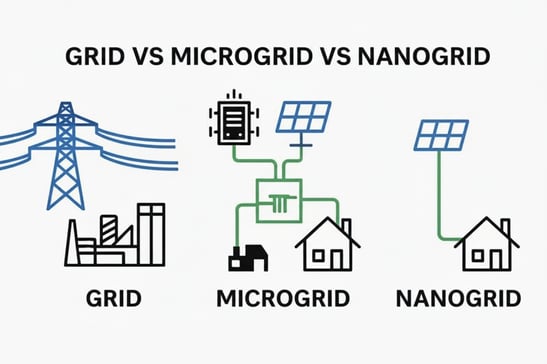
A. Technology Has Made Small-Scale Power Smarter
Advances in:
-
high-density lithium battery storage
-
compact high-efficiency solar generation
-
intelligent hybrid controllers
-
real-time load management
These factors have made it possible to create dependable power systems that are smaller, more modular, and more precise than traditional generator-based setups.
Where sites once needed a full 20–40 kW diesel generator “just in case,” operators can now deploy targeted 1–5 kW nanogrids or flexible 5–25 kW microgrids that scale with demand.
B. Mobility Requirements Have Changed
Modern field operations—whether a mobile telecom repeater, a roaming construction trailer, or a rapid-response command post—need power systems that can be:
-
shipped quickly
-
deployed without electricians
-
expanded as needed
-
moved site-to-site
Fully modular, towable, or palletized systems now outperform traditional fixed generators on both cost and convenience.
C. Sustainability Standards Are Tightening Everywhere
Organizations are under increasing pressure to:
-
Reduce fuel consumption
-
Cut emissions
-
Limit noise pollution
-
Improve operational efficiency
Microgrids and nanogrids directly support these goals by using solar and battery power as the primary energy source, with only limited generator support when required.
2. The Efficiency Shift: Why Right-Sized Power Is Replacing Diesel
One of the biggest drivers behind the growth of smaller grid systems is simple: diesel generators are often dramatically oversized for today’s applications.
Why Diesel Generators Are Often Overkill
Diesel generators are commonly rated for peak power but rarely operate at full load. In many off-grid or backup applications, they run at 20–40% capacity, wasting fuel and generating excess carbon and noise. Over time, this “oversizing” can double operating costs and shorten equipment life.
MOBISMART systems tackle this by right-sizing power generation. Solar arrays handle daytime loads, batteries smooth fluctuations, and intelligent control systems engage generators only during extended low-sun periods. The result: up to 80% reduction in diesel runtime and significantly lower emissions.
Most field assets—trailers, sensors, communication modules, cameras, lighting, workstations—have relatively low, stable energy profiles. Yet many sites still rely on 10–40 kW generators running loads that rarely exceed 1–5 kW.
This causes:
-
high fuel burn at low loads,
-
poor generator efficiency,
-
unnecessary emissions,
-
noise disruption, and
-
increased maintenance.
By contrast, a right-sized clean-energy system uses:
-
battery storage to deliver steady, efficient power,
-
solar to recharge throughout the day,
-
and a small generator only when needed.
This hybrid approach often cuts fuel consumption by 50–90%, depending on load and application.
3. Two Paths to Energy Independence
Path 1: Zero-Emission Fuel Cell Backup
Fuel cells generate electricity using hydrogen extracted from fuels such as methanol or propane, producing only water vapor. This is the ultimate independence solution:
• Zero emissions, silent operation, minimal maintenance
• No fuel deliveries, no oil changes, 40-60% efficiency
• One-time capital investment—no ongoing utility or fuel bills
• Perfect for zero-emission mandates and unreliable grid backup
Path 2: Intelligent Diesel Integration
For sites with established fuel logistics, smart diesel integration cuts consumption by 50-80%:
• Solar charges batteries during the day (free energy)
• Diesel generator only runs when batteries need charging
• Every kWh stored in a shared battery bank with solar
• Eliminates or drastically reduces utility bills while maintaining runtime flexibility
• Seamless upgrade path to fuel cells when ready
4. MOBISMART Solutions: Right-Sized Power for Every Application
MOBISMART’s portfolio is built around the exact trends driving grid evolution today: mobility, modularity, clean energy, and system intelligence.
Here’s how each solution aligns:
MOBISUN Hybrid Clean Power Trailers – 5kW and under Mobile Nanogrids
Towable, rugged trailers perfect for remote sites and mobile applications
-
Ideal for: Construction sites, mobile offices, telecom shelters, EV chargers, cameras, telecom equipment and repeaters, lighting, wind lidar and sensors, and cameras for mission-critical power
-
Why it works: Portable, silent, and completely off-grid
-
Benefit: Cuts fuel use dramatically while providing reliable hybrid power
MOBICELL Hybrid Clean Power Cabinets – 5-15 kW Mobile Microgrids
Hybrid systems that are integrated in enclosures on wheels or skid-mounted when a small footprint is necessary.
-
Ideal for: construction sites, admin offices, and temporary facilities
-
Why it works: Flexible solar + battery + optional small generator
-
Benefit: Eliminates expensive grid extensions.
MOBIPOWER-14K – 14 kW Diesel-Optimized Hybrid
Our flagship diesel-hybrid system for customers with established fuel logistics. The MOBIPOWER-14K proves energy independence doesn't mean sacrificing operational flexibility.
-
Ideal for: Utility operations, grid backup, defence, multi-asset sites
-
Why it works: High solar production, large storage, robust load management
-
Benefit: Solar + large battery bank + intelligently controlled genset delivers 50-80% fuel savings while eliminating utility dependence. Supports full site loads while limiting generator runtime to rare occasions
MOBIPOWER Containerized Microgrids – 5-20 kW
The MOBIPOWER-5–20K is a fully containerized hybrid power system engineered to replace diesel generators for large-scale, mission-critical applications.
-
Ideal for: construction compounds, regional telecom hubs, mining operations, and wind measurement farms
-
Why it works: High solar production, large storage, robust load management
-
Benefit: A modular system that can be combined efficiently.
Custom Engineered Systems – 25-60+ kW and Beyond
-
Ideal for: Industrial sites, remote communities, mining, and large-scale operations
-
Why it works: Designed for mission-critical reliability
-
Benefit: Purpose-built to replace or hybridize oversized diesel or unreliable grid infrastructure.
MOBISMART Product Comparison: Choosing the Right System for Modern Microgrids & Nanogrids
| System Type | Power Range | Best For | Key Strengths | Ideal Grid Size | Replaces / Reduces |
|---|---|---|---|---|---|
| MOBISUN Trailers |
5 kW | Construction sites, Cameras, sensors, telecom repeaters, lighting, IoT equipment, mobile offices, EV charging assist, telecom shelters | Towable, rapidly deployable, fully off-grid, modular solar + battery, optional generator hybrid | Nanogrid 5kW and under | Small-oversized 10-25 kW diesel generators |
| MOBICELL Cabinets | 5-15 kW | Construction admin offices, camps, small footprint sites. Modular. Skid-mounted or towable trailer | Eliminates grid extension costs with a small footprint | Microgrids (5–15 kW) | Small-oversized 20–40 kW diesel generators |
| MOBIPOWER Containers | 5–20 kW | Utility operations, emergency response, defense, multi-load field sites | High solar production, large storage, intelligent controls | Microgrids (15–50+ kW) | Continuous generator use, high fuel consumption |
| Custom Engineered Microgrid Solutions | 25–60+ kW | Industrial sites, mining, remote communities, multi-site power | Designed for mission-critical uptime, scalable modular design | microgrids or distributed sites | Full-time diesel generator reliance |
5. FAQs
Why are smaller grid systems gaining traction now?
Improved batteries, more efficient solar, and intelligent hybrid controls allow compact systems to deliver the same reliability as large generators—with far lower fuel costs.
Can I reduce generator use without compromising uptime?
Yes. Most loads can be served primarily by solar and battery power, with a small generator used only for peak surges or extended cloudy periods.
Why invest in energy independence when I have grid power?
Grid reliability is declining while rates rise 5-10% annually. MOBISMART systems provide backup during outages and can eliminate utility bills—paying for themselves through avoided operating costs.
What about remote locations without grid access?
Grid extension costs $50,000-$150,000 per mile. Our off-grid systems provide complete independence as a one-time capital investment—no utility bills, ever.
Can I really eliminate utility bills?
Yes. Solar generates free electricity, batteries store it, and backup (fuel cell or optimized diesel) handles extended needs. One capital investment replaces endless monthly payments.
Do MOBISMART systems integrate with existing diesel generators?
Absolutely. They can operate standalone or act as hybrid controllers, dramatically reducing generator runtime.
The Bottom Line
Grid infrastructure can't keep pace with demand from EVs, data centers, and electrification. Utility rates keep rising. Remote sites can't access the grid at all.
Microgrids and nanogrids aren’t emerging—they’re becoming the default for field power. Better batteries, smarter controls, and cleaner hybrid systems mean organizations can finally move beyond oversized diesel generators toward right-sized, low-fuel mobile power.
MOBISMART delivers this modern approach: modular clean power that scales with your site and eliminates the waste, fuel burn, and inefficiency of traditional generators through two proven paths:
- Fuel cell backup: Zero emissions, minimal operating costs, complete independence
- Intelligent diesel integration: 50-80% fuel savings while maintaining flexibility
Whether you're off-grid by necessity or seeking backup against grid unreliability, MOBISMART systems deliver one-time capital investment instead of endless operating costs—with freedom from utility rate increases and resilience against grid failures.
Key Takeaway
The right power system balances capacity, efficiency, and adaptability. Microgrids and nanogrids both deliver resilience and energy independence — but scale matters. By matching the right MOBISMART clean-power solution to your grid size, you can eliminate diesel waste, cut emissions, and achieve sustainable performance in any environment.
Get Started
Visit mobismart.com to explore our complete range of hybrid microgrid and nanogrid solutions.
Ready for energy independence? Contact our team to discuss whether fuel cell backup or intelligent diesel integration is right for your project.